Is Puerto Vallarta a good place to learn?
Puerto Vallarta can be a useful base for learning because several coastlines around Bahía de Banderas respond differently to swell. That variety may create options, but it does not make every nearby beach—or any named beach—suitable every day. Some shores are sheltered from one direction and exposed to another. Tide can change the wave shape and entry; wind can roughen the surface; swell period can add more power than its height suggests; weather and rain can affect safety and water quality.
The honest answer is conditional: it is a good place to learn when a qualified instructor finds a learning area that matches your swimming ability, confidence, mobility, and goals on that day. Current observations matter more than a photo, monthly average, or famous place name. A responsible plan may change the meeting time, choose another area, keep practice in broken waves, or postpone surfing.
Read the complete Puerto Vallarta surf guide for regional context and the seasonal surf guide for broad patterns. Neither replaces an on-the-beach assessment.
What beginners should expect during a first lesson
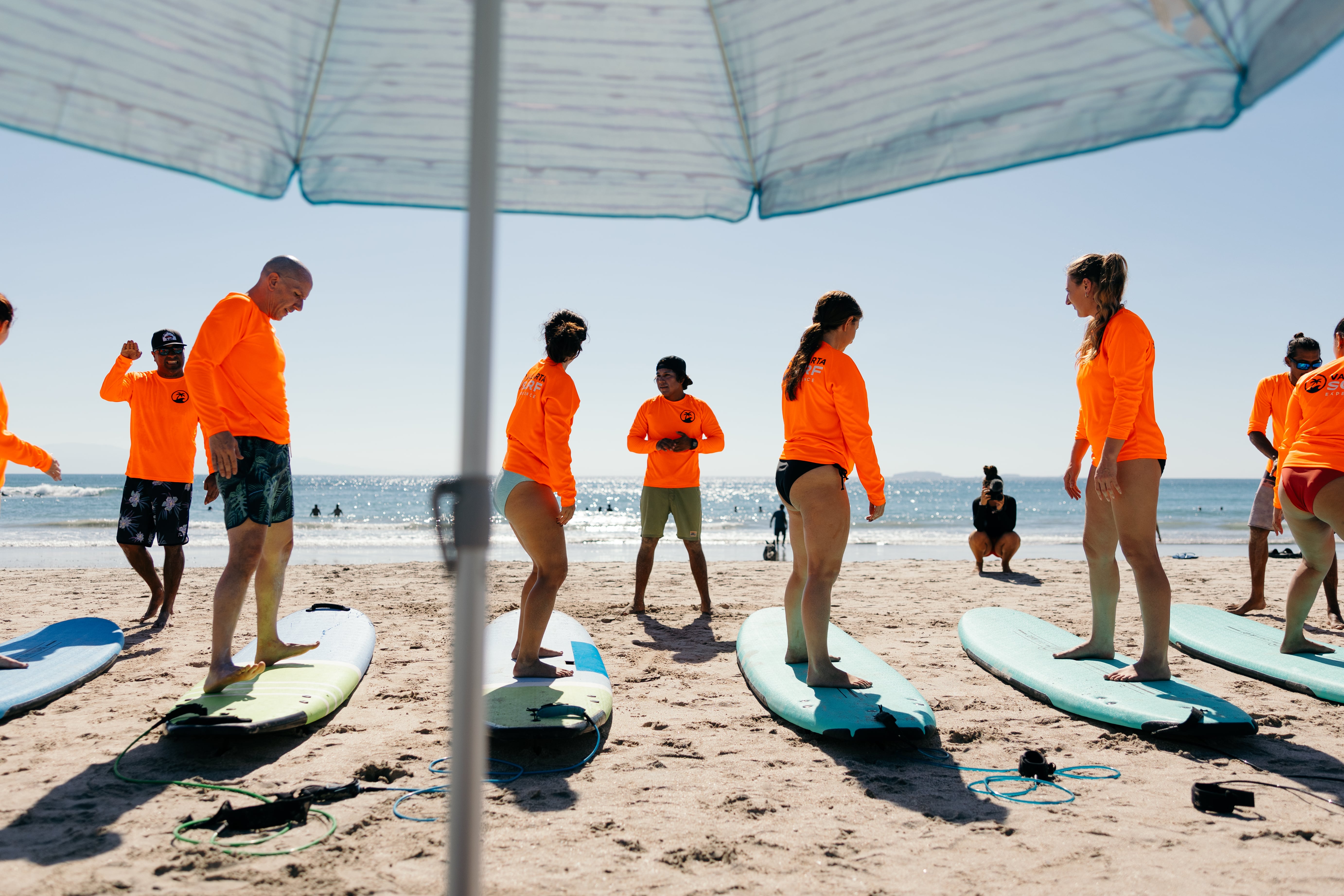
A first lesson commonly begins away from breaking waves. The instructor should ask about swimming, injuries, previous board sports, comfort in the ocean, and what you hope to learn. Then comes a conditions briefing: boundaries, bottom, current, entry and exit, wind, tide, swell, weather, other water users, and the signal for returning to shore. Speak up if a term or instruction is unclear. Travelers choosing how that attention is distributed can compare private and group surf lesson formats.
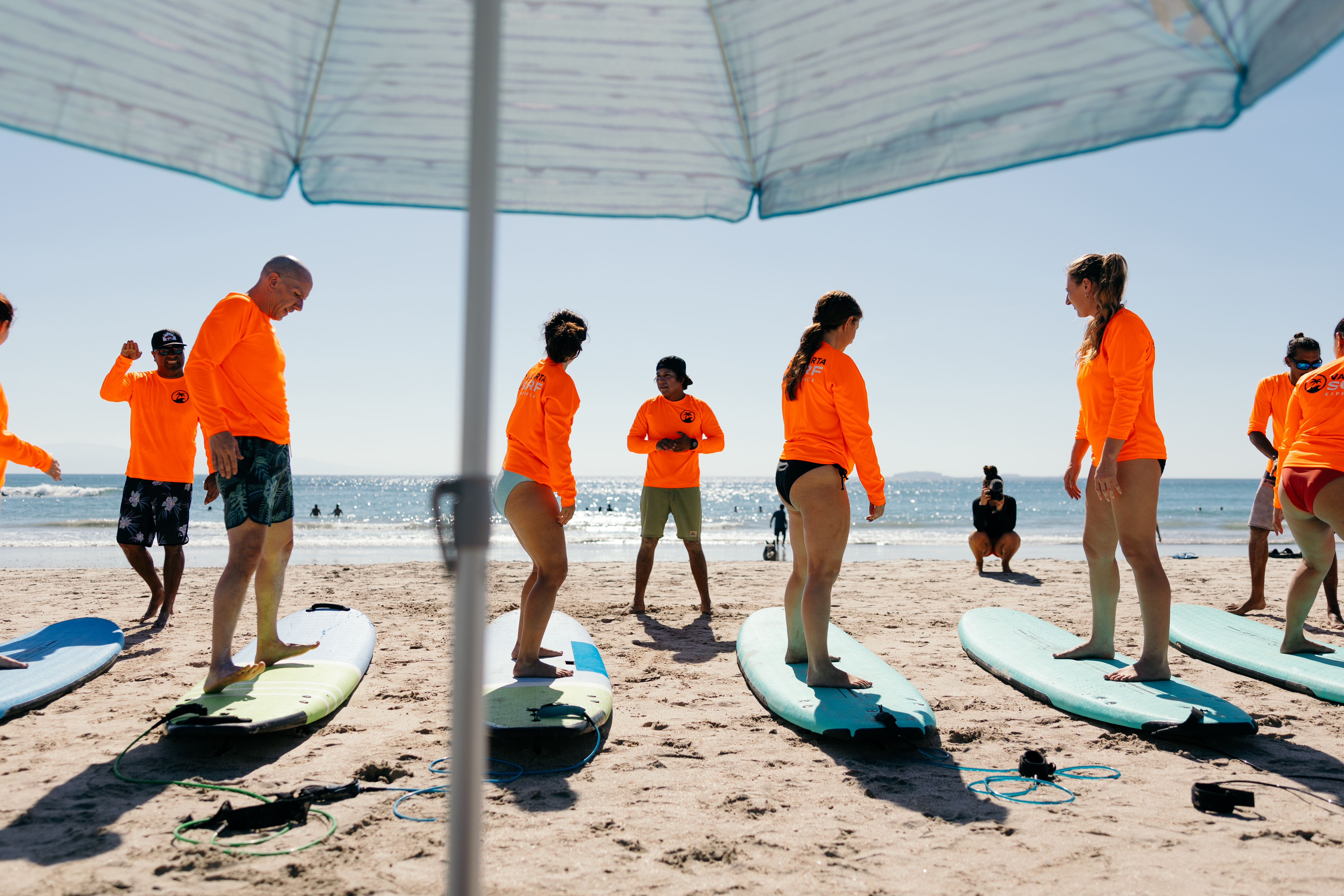
On land, you may learn board parts, safe carrying, a balanced prone position, paddling, and a simple way to move into your stance. A dry-land rehearsal lets the instructor notice where your hands, knees, and feet naturally go. There is no need to force a textbook movement that conflicts with a genuine mobility limit; the instructor can simplify the sequence while preserving control.
In the water, many beginners start with controlled broken waves rather than paddling into an open lineup. The instructor may steady or guide the board at first, then reduce help as your control improves. Expect pauses for feedback and recovery. A session can include more waiting and observation than visitors expect because waves arrive in sets and the learning lane must remain clear.
Standing is only one possible result, not the definition of success. Learning to fall away from the board, protect your head when resurfacing, stop the board, notice other people, and finish within your energy limit are meaningful first-session skills. No ethical guide can promise that everyone stands or that one lesson guarantees success.
Choosing conditions instead of chasing big waves
Beginners need opportunity, not spectacle. Smaller, slower waves with a predictable breaking pattern generally allow more attempts and clearer feedback than powerful surf. Yet “small” from shore does not automatically mean safe. Shorebreak, rocks, a strong channel, crowded water, or a rapid tide change can make an apparently modest day inappropriate.
Wave height is only one input. An instructor should consider swell direction and period, tide stage and movement, wind strength and direction, weather, visibility, recent rain, current, crowd density, and direct observations. Your ability and energy complete the picture. If those pieces do not align, changing the location or skipping the session is good judgment—not a missed opportunity.
Equipment explained simply
The surfboard should help you practice, not test your ego. Beginners often use a longer, wider, higher-volume soft-top because it floats well and offers stability. The correct choice still depends on body size, mobility, the learning area, and conditions. A smaller board may look appealing but usually makes paddling, balance, and wave entry harder.
The leash connects the board to the surfer and must be the right length and in sound condition. It is not a rescue device, and you should never deliberately rely on it to control a loose board. Fins help the board track and turn; keep feet and hands clear when falling. A rash guard reduces friction and sun exposure, while suitable swimwear should stay secure in moving water. Depending on water temperature and sensitivity, an instructor may recommend other protection.
Inspect equipment before entering: leash cord and rail saver, fin security, board surface, and any sharp damage. Sun protection, drinking water, and footwear for the access path belong in the plan. Renting or using lesson equipment first is sensible; you do not need to buy a board for an initial session.
Common beginner mistakes
The most common mistake is looking down. Your head guides posture, so look toward where you want to travel. Other frequent issues include placing hands too far forward during the stand-up, rising in several unstable stages, standing upright with locked knees, or putting both feet on one side of the centerline. Good feedback focuses on one correction at a time.
In the water, beginners may hold the board sideways to incoming whitewater, wrap the leash around fingers, stand where a loose board can strike them, or turn their back before checking the next wave. Another mistake is continuing after fatigue has reduced judgment. Tell the instructor when you are tired, cold, anxious, or in pain.
The broader planning mistakes are more serious: choosing a spot by reputation, copying an experienced surfer, assuming yesterday's tide and wind will repeat, or entering before identifying a safe exit. Slow down, observe several sets, and accept the instructor's decision when ability, swell, tide, wind, weather, or current observations call for a different plan.
Ocean safety basics
Confident swimming is a prerequisite, but pool skill and ocean awareness are different. Waves, current, uneven bottom, and limited visibility add stress. Before entering, identify boundaries, landmarks, the planned entry and exit, hazards, and the instructor's recall signal. Stay within the designated area and never surf alone as a first-timer.
Rip currents are focused flows moving away from shore. Warning signs can include a channel of disturbed or differently colored water, but they are not always obvious. If caught, conserve energy, signal for help, avoid fighting directly against the flow, and follow trained local or lifeguard instructions. NOAA's guidance explains swimming parallel to shore or toward breaking waves when able, then returning at an angle. Local circumstances still govern the response.
Protect your head after a fall and surface cautiously because the board may be nearby. Do not dive headfirst into unknown depth. Leave the water for thunder, deteriorating visibility, injury, equipment failure, exhaustion, or an instructor recall. Heavy rain, runoff, tropical weather, changing wind, tide, or swell may justify postponement even when waves look inviting.
Surf etiquette for first-timers
Etiquette is a collision-prevention system and a way to share limited space. In a lineup, the surfer closest to the breaking part of the wave generally has priority. Do not take off in front of that surfer, repeatedly paddle around others for position, or assume a lesson grants special access. For early whitewater practice, follow the instructor's defined lanes and check that nobody is in your path.
Maintain control of the board whenever possible. Never throw it toward another person, and do not paddle directly into a rider's line. Communicate, apologize when you make an error, wait your turn, and give other beginners space. Observe the lineup before entering and respect lifeguards, instructors, fishers, swimmers, access rules, wildlife, and local residents. Pack out everything you bring and avoid broadcasting low-capacity locations.
Physical preparation
In the weeks before a first surfing experience, regular swimming is the most relevant preparation. Add comfortable walking or other aerobic activity, gentle shoulder mobility, trunk stability, and controlled floor-to-standing movements. Practice quality rather than exhausting repetitions. If kneeling, wrist loading, or rotating the hips causes pain, ask a clinician or qualified trainer for individual advice.
Arrive rested, hydrated, and fed with enough time to avoid rushing. Avoid alcohol or impairing substances. Tell the instructor about medical conditions, medication, recent injury, pregnancy, or mobility limits before the session. Preparation does not override conditions: even a fit athlete is a novice at reading swell, current, wind, tide, and local hazards.
Mental expectations
Surfing asks you to learn in a moving environment. You may miss waves, lose balance, repeat the same correction, or feel briefly disoriented after falling. That is ordinary information, not failure. A useful goal for lesson one is to become calmer and more observant while controlling the board responsibly.
Nervousness deserves attention rather than embarrassment. Tell the instructor what worries you: submersion, deep water, marine life, collisions, or simply not knowing what happens next. A clear boundary and step-by-step explanation can reduce uncertainty. You retain the right to stop. Remaining on land for another demonstration or ending early can be the safest, most productive decision.
Compare yourself only with your earlier attempts. Athletic background can help coordination, but it does not guarantee fast progress; fear, fatigue, wave timing, mobility, equipment, and conditions affect each learner differently. Photos and short videos often hide missed attempts and waiting, so do not use social media as a standard. Ask for a pause when overwhelmed. An instructor should adjust the task to your ability rather than pressure you into deeper or larger surf.
What progress usually looks like
Progress is rarely linear. Early milestones may include carrying the board safely, choosing a stable position, catching broken waves with help, falling well, and recognizing the session boundaries. Later, a learner may paddle with better timing, enter waves with less assistance, stand more consistently, trim in both directions, and make simple decisions around others.
A short post-session note can make progress easier to see. Record the board used, learning zone, tide, approximate swell, wind, weather, what felt comfortable, and one instruction to revisit. These notes are not a formula for returning without guidance: they show how much the environment changes and give a future instructor useful context. Rest and recovery count too. Repeating tired, uncontrolled attempts tends to reinforce poor movement.
Moving beyond supervised whitewater requires a larger skill set: reading sets, selecting waves, turtle-rolling or otherwise managing incoming water with the chosen board, reaching an appropriate lineup, respecting priority, controlling speed and direction, and returning through the correct exit. Most importantly, an independent surfer must know when not to enter. Ask for specific feedback on board control and decision-making, rather than asking only whether you stood often enough.
No fixed lesson count produces independence. Frequency, feedback, fitness, ability, conditions, and time between sessions all change the curve. If you want to understand available instruction without turning this guide into a booking pitch, the lesson-format overview explains the options. Private instruction can allow individual pacing; a private group lesson keeps known companions together; and a shared group lesson involves other participants. The correct format still depends on learner needs, instructor judgment, and that day's tide, wind, swell, weather, and observations.
Frequently asked questions
Do I need to know how to swim before a surf lesson?
Yes. You should be able to swim confidently and feel reasonably comfortable in moving ocean water. Tell the instructor honestly about your swimming ability, health, and anxiety; they must decide whether the current tide, wind, swell, weather, and learning area are appropriate.
Am I too old to learn to surf?
Age alone does not decide whether someone can begin. Mobility, balance, swimming ability, health, recovery, and current ocean conditions matter more. Discuss medical concerns with a qualified clinician and tell the instructor about limitations so the session can be adapted or postponed.
How fit do I need to be for a first lesson?
You do not need elite fitness, but swimming, repeated transitions from lying to standing, and walking through moving water require effort. Basic aerobic capacity, shoulder mobility, and the ability to rise safely from the floor help. Conditions and lesson pacing should match your ability.
Should I buy a surfboard before my first lesson?
Usually not. A lesson board can be selected for your size, ability, and the day's conditions. After several sessions you will understand board volume, length, and stability better, making a future purchase more informed.
How many lessons do I need before surfing alone?
There is no dependable number. Independent surfing requires more than standing: you must assess swell, tide, wind, weather, currents, entry and exit, crowds, equipment, and etiquette. Ask an instructor to evaluate your decisions and board control, and continue with supervision until you can manage them consistently.
Sources and local review
External factual guidance:
- Rip Current Science, NOAA Ocean Service — Official explanation of rip-current behavior and general response guidance.
- Beach and Ocean Safety, United States Lifesaving Association — Public water-safety guidance on swimming ability, lifeguards, waves, and unfamiliar beaches.
- Lightning Safety, U.S. National Weather Service — Official guidance for leaving water and exposed outdoor areas when thunder threatens.
- Servicio Meteorológico Nacional, CONAGUA — Official Mexican weather forecasts and warnings to check near the session date.
First-hand local editorial guidance: Manual local review of beginner lesson sequence, equipment framing, Bahía de Banderas condition variability, safety and etiquette language, realistic progression, and commercial boundaries. Suitability must still be decided from ability, instructor judgment, tide, wind, swell, weather, and current observations. Reviewed by Buena Ola Surf Co. Editorial Team on .